Understanding Your Options: Japan Pocket WiFi
A Japan pocket WiFi, often referred to as a portable WiFi device or MiFi, is a small, battery-powered gadget that acts as a personal hotspot. It connects to Japan’s cellular network and then broadcasts a private Wi-Fi signal, allowing multiple devices (smartphones, tablets, laptops, etc.) to connect to the internet simultaneously. Think of it as having your own personal, mobile Wi-Fi router that you carry with you everywhere.
How Japan Pocket WiFi Works
The process is generally straightforward. You rent the device for the duration of your trip. Upon arrival, you pick it up at a designated counter (often at major international airports like Narita, Haneda, or Kansai), or have it delivered to your accommodation. Once you power it on, it creates a Wi-Fi network with a unique name (SSID) and password. You then simply connect your devices to this network, just as you would with any other Wi-Fi hotspot. At the end of your trip, you return the device, usually by dropping it in a designated mailbox at the airport or mailing it back via post.
Advantages of Choosing a Japan Pocket WiFi
- Shareability: This is arguably the biggest selling point for pocket WiFi. A single device can typically connect 5-10 devices simultaneously, making it ideal for families, couples, or groups traveling together. Imagine exploring What To Do In Onomichi Japan with friends, and everyone can look up restaurant reviews or temple opening hours without needing individual SIM cards.
- Dedicated Device, Less Phone Battery Drain: Since the pocket WiFi handles all the cellular data processing, your phone’s battery is conserved for other tasks like taking photos at Onomichi Photography Spots or using offline maps.
- Ease of Use: For many, it’s a “set it and forget it” solution. Once connected, all your devices have internet access. There’s no need to swap SIM cards or worry about phone compatibility.
- Consistent Performance: Pocket WiFi devices are optimized for consistent internet access, often providing strong 4G LTE or even 5G speeds across major providers like NTT Docomo, SoftBank, or au. This means reliable streaming and fast downloads, crucial for looking up last-minute ferry schedules for an Innoshima Japan Travel Guide day trip.
- Privacy and Security: Unlike public Wi-Fi hotspots, your pocket WiFi creates a private, password-protected network, offering a more secure connection for sensitive tasks like online banking or accessing personal information.
- Unlimited Data Options: Many providers offer “unlimited” data plans (though often with a fair usage policy, meaning speeds might throttle after a very high threshold). This provides peace of mind for heavy data users.
Disadvantages of Choosing a Japan Pocket WiFi
- Another Device to Carry: You’ll have an additional gadget in your bag, along with its charger and possibly a power bank. This can be cumbersome, especially if you prefer to travel light while exploring the hilly streets of Onomichi.
- Battery Life: While dedicated, the device’s battery will eventually run out, typically lasting 8-12 hours on a full charge. You’ll need to remember to charge it overnight and potentially carry a power bank during long days out.
- Pick-up and Return Logistics: While convenient, you’ll need to factor in time for picking up the device upon arrival and returning it before departure. Missed return deadlines can incur extra charges.
- Cost for Solo Travelers: For a single traveler, a pocket WiFi can sometimes be more expensive than a SIM card, as you’re paying for the device rental and the ability to connect multiple devices, even if you only use one.
- Dependence on One Device: If the pocket WiFi device is lost, stolen, or damaged, your entire group loses internet access.
- No Local Phone Number: Pocket WiFi only provides internet access; it does not come with a Japanese phone number, meaning you can’t make or receive traditional calls unless you use VoIP apps like WhatsApp or Skype.
Who Should Choose a Japan Pocket WiFi?
A pocket WiFi is an excellent choice for:
- Families or groups traveling together who want to share internet access.
- Travelers carrying multiple Wi-Fi enabled devices (smartphone, tablet, laptop).
- Individuals who prefer not to tamper with their phone’s SIM slot or worry about phone compatibility.
- Heavy data users who benefit from “unlimited” data plans.
- Business travelers needing a reliable and secure connection for work on the go.
Understanding Your Options: Japan SIM Card (Physical & eSIM)
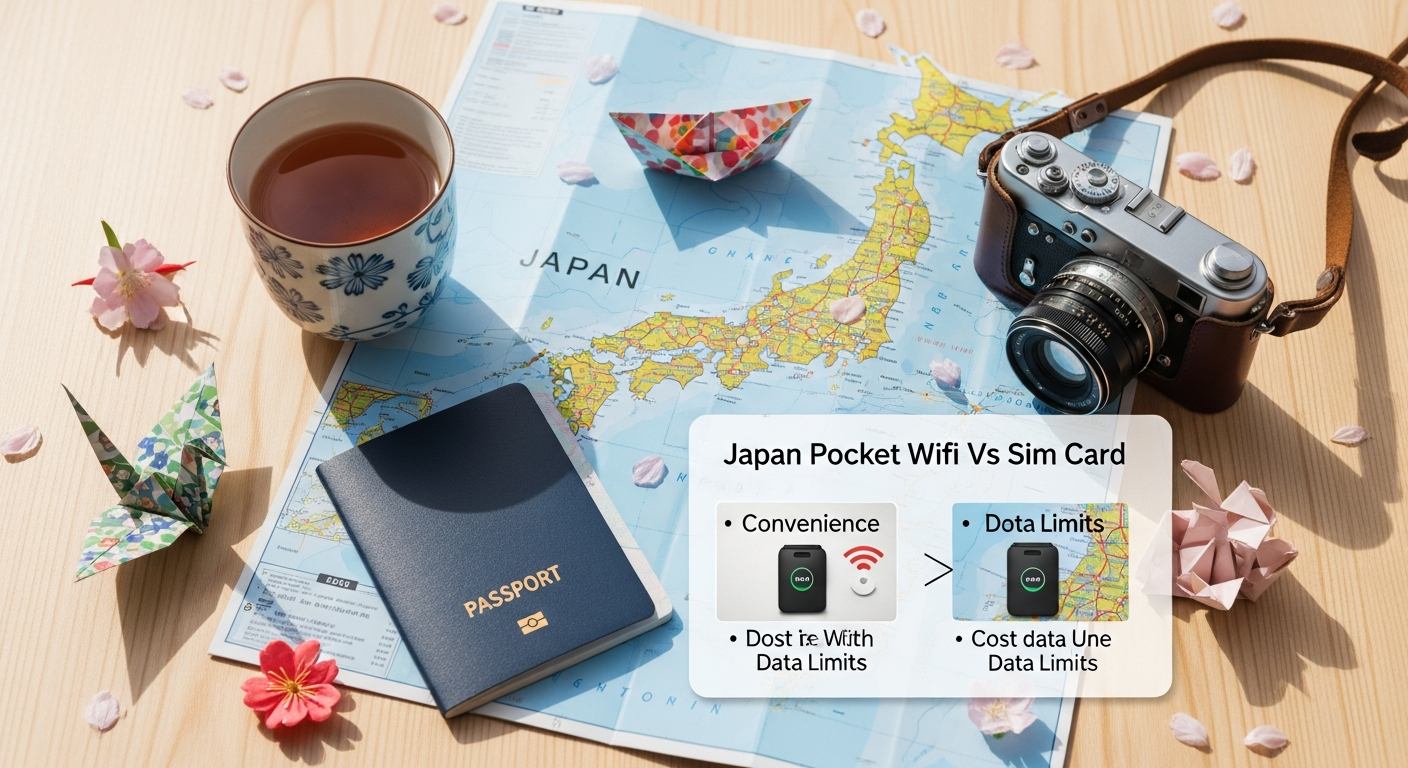
A Japan SIM card, whether physical or an eSIM, allows your smartphone to directly connect to Japan’s cellular network. Instead of creating a separate Wi-Fi hotspot, your phone itself becomes the internet access point, providing data directly to your device.
How Japan SIM Cards Work
Physical SIM Card: This is a small chip that you insert into your unlocked smartphone’s SIM card slot, replacing your home country’s SIM. Once inserted and configured (which might involve changing APN settings, though many tourist SIMs are plug-and-play), your phone will connect to a local Japanese network. You can purchase these online before your trip, at Japanese airports, or sometimes at electronics stores.
eSIM (Embedded SIM): An eSIM is a digital SIM profile that’s pre-installed or downloaded onto compatible smartphones. Instead of a physical chip, the SIM information is stored electronically. You typically purchase an eSIM plan online, receive a QR code or activation details, and then activate it through your phone’s settings. This allows for instant activation without needing to physically swap cards.
Advantages of Choosing a Japan SIM Card (Physical or eSIM)
- No Extra Device to Carry: This is the primary advantage. Your phone is your internet device, reducing clutter in your bag as you explore the temples and slopes of Onomichi.
- Instant Connectivity: Once activated, your phone has immediate internet access. With an eSIM, activation can often happen even before you land, ensuring you’re connected the moment you step off the plane.
- Cost-Effective for Solo Travelers: For individuals, a SIM card (especially an eSIM) can often be more economical than renting a pocket WiFi device, as you’re only paying for the data you use on one device.
- Local Phone Number (Rare but Possible): Some long-term tourist SIMs or specific plans might offer a Japanese phone number for calls and SMS, which can be useful for making local reservations or contacting local services. However, most short-term tourist SIMs are data-only.
- Convenience of eSIM: For compatible phones, eSIMs offer unparalleled convenience. No physical card to lose, no fumbling with tiny trays, and you can often keep your home country’s SIM active for receiving calls/SMS while using the eSIM for data. This is particularly handy if you need to receive important messages from banks or other services while traveling.
- No Pick-up/Return Logistics: With an eSIM, there are no physical items to pick up or return, simplifying your travel logistics. Physical SIMs still require pick-up or delivery, but no return.
Disadvantages of Choosing a Japan SIM Card (Physical or eSIM)
- Phone Compatibility: This is the biggest hurdle. Your smartphone MUST be unlocked by your home carrier to use a foreign SIM card. Many phones purchased on contract are carrier-locked. Also, not all phones support eSIM technology. Always check your phone’s compatibility before purchasing.
- Installation (Physical SIM): Swapping physical SIM cards can be fiddly. You need a SIM ejector tool (or a paperclip), and there’s a risk of losing your home SIM card.
- Battery Drain on Your Phone: Your phone will be working harder to maintain a cellular connection and serve data, potentially draining its battery faster. You might find yourself needing to charge your phone more frequently, especially if you’re heavily relying on it for navigation, like finding the best viewpoint at Onomichi Photography Spots.
- Single Device Use: A SIM card provides internet only to the phone it’s installed in. While you can tether (create a personal hotspot from your phone), this further drains your phone’s battery and might be restricted by the SIM card’s data plan or provider.
- Data Limits: Many tourist SIM cards come with fixed data allowances (e.g., 5GB, 10GB, 20GB). While this is often sufficient for typical tourist use, heavy streamers or those uploading large files might hit their limit. “Unlimited” SIMs exist but often come with speed throttling after a certain usage threshold.
- Lack of Flexibility for Groups: If traveling in a group, each person would ideally need their own SIM card, which can be more expensive and less coordinated than a single pocket WiFi.
Who Should Choose a Japan SIM Card?
A SIM card (especially eSIM) is an excellent choice for:
- Solo travelers or couples who each want independent connectivity.
- Travelers with unlocked, eSIM-compatible smartphones.
- Those who prefer to travel light and avoid carrying extra gadgets.
- Individuals who want to be connected immediately upon arrival.
- Travelers who primarily use their smartphone for internet access.
Key Factors for Your Decision: A Head-to-Head Comparison
Cost
- Pocket WiFi: Rental costs typically range from JPY 500-1,000 per day, often with discounts for longer rentals. While seemingly higher daily, the cost can be split among multiple users, making it more economical per person for groups. Be aware of potential delivery fees, insurance options, and late return penalties.
- SIM Card: Prices vary widely based on data allowance and duration. A 7-day, 5GB data SIM might cost around JPY 2,000-3,000. A 30-day, 20GB SIM could be JPY 5,000-7,000. eSIMs often have similar pricing structures. For a solo traveler, a SIM card is often the cheaper option, but for groups of 3+, pocket WiFi might be more cost-effective.
Convenience & Logistics
- Pocket WiFi: Requires pre-booking and either airport pick-up/return or delivery/mail-back. This adds a small logistical step at the beginning and end of your journey. Keeping it charged is another consideration throughout your stay, especially during long days exploring places like Innoshima.
- SIM Card:
- Physical SIM: Can be picked up at the airport or delivered. Installation involves swapping your home SIM, which can be quick or fiddly. No return needed.
- eSIM: The most convenient option. Purchase online, activate via QR code, and you’re connected. No physical handling, no pick-up/return. This is ideal for maximizing your time, especially if you’re eager to start exploring What To Do In Onomichi Japan right away.
Device Compatibility
- Pocket WiFi: Universally compatible with any Wi-Fi enabled device (smartphone, tablet, laptop). No issues with carrier locks.
- SIM Card:
- Physical SIM: Requires an unlocked smartphone with a compatible SIM slot.
- eSIM: Requires an eSIM-compatible and unlocked smartphone. Ensure your device supports eSIM before purchasing.
Data Usage & Speed
- Pocket WiFi: Many plans offer “unlimited” data (subject to fair use policies, meaning very high usage might lead to throttling). Speeds are generally excellent (4G LTE, increasingly 5G in urban areas). This is great if you plan to share lots of high-resolution photos from Onomichi Photography Spots or stream videos.
- SIM Card: Most tourist SIMs come with fixed data allowances (e.g., 5GB, 10GB, 20GB). “Unlimited” SIMs are available but often have stricter fair use policies than pocket WiFi, with lower thresholds for speed throttling. Speeds are typically excellent, matching the local network quality.
Group Travel vs. Solo Travel
- Pocket WiFi: Shines for groups. One device covers everyone, simplifying connectivity and often reducing per-person costs.
- SIM Card: Best for solo travelers or couples who prefer independent connectivity. For larger groups, purchasing multiple SIMs can become more expensive and less coordinated.
Battery Life
- Pocket WiFi: Has its own battery, typically lasting 8-12 hours. You’ll need to carry it and charge it.
- SIM Card: Uses your phone’s battery. Heavy data usage will drain your phone faster, potentially requiring a power bank.
Security
- Pocket WiFi: Creates a private, password-protected network, offering better security than public Wi-Fi.
- SIM Card: Connects directly to the cellular network, which is generally secure. Using your phone as a hotspot for others is also secure.
Practical Considerations for Your 2026 Japan Trip
Beyond the direct comparison, a few practical tips will help you integrate your chosen connectivity solution seamlessly into your Japan adventure.
Booking in Advance
For both pocket WiFi and SIM cards, especially if you’re visiting during peak seasons (Cherry Blossom in spring, Autumn leaves, or national holidays), it’s highly recommended to book your device or purchase your SIM/eSIM well in advance. This ensures availability and often secures better rates. Providers can sell out, especially for airport pick-up options.
Airport Pick-up vs. Delivery
Most major airports in Japan (Narita, Haneda, Kansai, Chubu, Fukuoka, etc.) have counters for pocket WiFi and SIM card providers. This is often the most convenient option, allowing you to get connected immediately upon arrival. Alternatively, many services offer delivery to your first accommodation (hotel, Airbnb, etc.) in Japan. For returns, airport drop-boxes are common for pocket WiFi, or you can mail it back from any Japanese post box. The convenience of picking up your pocket WiFi at Hiroshima Airport, for example, before heading to Onomichi, can save you precious travel time.
Understanding Data Plans and Fair Use Policies
While many plans advertise “unlimited” data, it’s crucial to read the fine print regarding fair use policies. These policies are designed to prevent network congestion from excessive data usage. Typically, if you consume a very large amount of data within a short period (e.g., several gigabytes in a single day), your speed might be temporarily throttled. For most tourist activities—browsing maps for What To Do In Onomichi Japan, social media, light video streaming, messaging—this won’t be an issue. However, if you plan to download large files, stream hours of HD video, or engage in heavy online gaming, be aware of these potential limitations.
Troubleshooting Common Issues
Pocket WiFi: If you experience slow speeds or connection issues, try restarting the device and ensuring it’s fully charged. Check the signal strength indicator on the device itself. Sometimes, a temporary network issue might be at play, similar to what you might experience with your home network.
SIM Card (Physical): Ensure the SIM is correctly inserted. Check your phone’s APN settings (usually found under Cellular Data or Mobile Network settings). Sometimes, a simple phone restart can resolve connectivity issues.
eSIM: Verify that your eSIM profile is activated in your phone’s settings and that it’s selected for cellular data. Ensure data roaming is enabled for your eSIM if necessary (though most Japan tourist eSIMs are designed for local network use). Check for any profile updates from the provider.
Specific Advice for Longer Trips or Remote Areas
For extended stays beyond a few weeks, consider whether a long-term rental pocket WiFi or a longer-duration SIM card offers better value. For remote areas, like some of the islands accessible from Onomichi for an Innoshima Japan Travel Guide adventure, network coverage can sometimes be spottier than in major cities. All major providers (Docomo, SoftBank, au) have excellent coverage nationwide, but it’s always wise to check their coverage maps if you plan to venture far off the beaten path. A pocket WiFi might have a slightly stronger antenna than a phone, potentially giving it a minor edge in very fringe areas, but generally, coverage will be similar.
Onomichi Guide’s Recommendation: Tailoring Your Connectivity Choice
Ultimately, the “best” option between Japan pocket WiFi and a SIM card for your 2026 trip depends entirely on your specific travel style, budget, and technological comfort level. Here’s a summary to help you make your final decision:
Choose a Japan Pocket WiFi if:
- You are traveling with family or a group and want to share internet access easily.
- You plan to use multiple devices (phone, tablet, laptop) and want them all connected.
- You prefer not to touch your phone’s SIM card slot or worry about phone compatibility (e.g., if your phone is carrier-locked).
- You are a heavy data user and prefer the peace of mind of “unlimited” plans (with fair use policies in mind).
- You want a dedicated device to handle internet connectivity, conserving your phone’s battery.
- You value the security of a private Wi-Fi network over public hotspots.
Imagine your group climbing the steep paths to Senkoji Temple, capturing stunning views for Onomichi Photography Spots. With a pocket WiFi, everyone can instantly share their photos, look up the next temple on the path, or find a charming café in the alleyways of Onomichi without hassle.
Choose a Japan SIM Card (Physical or eSIM) if:
- You are a solo traveler or a couple who each want independent connectivity.
- You have an unlocked smartphone (and ideally, one that is eSIM compatible for maximum convenience).
- You prioritize traveling light and don’t want to carry an extra device.
- You want immediate connectivity upon arrival, especially with an eSIM that can be activated before you land.
- You are comfortable with a fixed data allowance or prefer a more budget-friendly option for individual use.
- You primarily use your smartphone for all your internet needs.
Picture yourself navigating the intricate ferry routes to Innoshima using Google Maps, or quickly translating a menu at a local eatery in Onomichi. An eSIM offers unparalleled ease for these moments, ensuring you’re connected the second you need it without any extra bulk.
No matter which option you choose, securing your internet connectivity before you depart for Japan is a critical step in ensuring a smooth and enjoyable journey. Both Japan pocket WiFi and SIM cards offer robust solutions to keep you connected, informed, and ready to capture every moment of your unforgettable 2026 adventure in Japan, from the historic charm of Onomichi to the tranquil beauty of Innoshima and beyond. Plan wisely, connect confidently, and immerse yourself fully in the wonders of Japan!
Frequently Asked Questions
Recommended Resources
You might also enjoy How To Plan A Disney World Trip On A Budget from Vacation Rental Planners.
Learn more about this topic in Best Family Vacation Destinations 2026 at Vacation Rental Planners.